
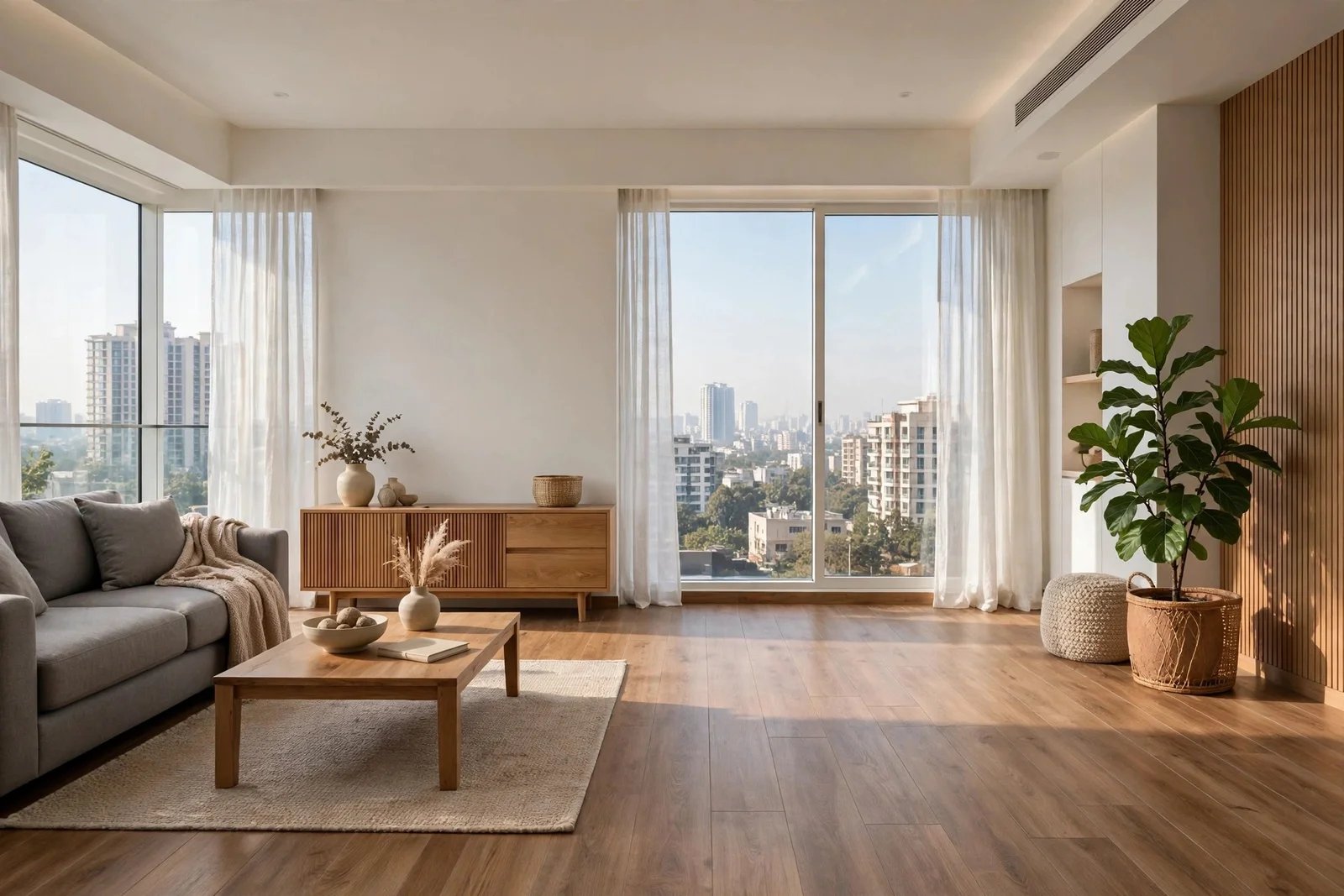
A spilled glass of water on a wooden floor is a small disaster. The water seeps in, the boards swell, the edges lift, and a floor that cost lakhs starts looking old in a year. So before anyone spends money on new flooring, one question comes first — is SPC flooring waterproof? The short answer is yes: SPC flooring is 100% waterproof. But “waterproof” has limits, and knowing exactly where those limits are is what decides whether SPC is right for your kitchen, your bedroom or your office. This guide gives you the straight answer, room by room, with verified prices from Goals Floors in Gurugram — so you can decide with facts, not sales talk.
Is SPC flooring waterproof? The short answer
Yes — is SPC flooring waterproof is a question with a clear answer: SPC flooring is 100% waterproof. The plank itself does not absorb water, does not swell and does not warp when it gets wet. That is not a coating or a surface treatment that wears off; it is the material itself. SPC stands for Stone Plastic Composite — a rigid core made of limestone powder, stabilisers and PVC — and stone does not drink water the way wood fibre does. Goals Floors states it plainly on its own product page: SPC flooring is fully waterproof and can withstand spills, moisture and humidity without swelling or warping.
Here is the room-by-room verdict in one table.
| Room | Is SPC flooring waterproof enough? | Verdict |
|---|---|---|
| Kitchen | Yes — spills, splashes, steam, daily mopping | Best use case |
| Bedroom | Yes — and warm underfoot, silent with cushion layer | Excellent |
| Office | Yes — heavy footfall, chair wheels, tea spills | Excellent |
| Bathroom (floor, outside shower) | Yes, with sealed edges and wiped standing water | Good, with care |
| Balcony / outdoor | No — not an outdoor product | Avoid |
| Shower floor / permanently wet area | No — standing water needs tiles | Avoid |
The one honest caveat: a waterproof plank is not the same as a waterproof floor. The click-lock joints between planks are tight, but if a room is flooded and water sits for hours, some of it can seep through the joints to the subfloor below. That is why the product page says you can mop daily with a damp mop, but advises against throwing buckets of water on the floor. Used the way a home floor is meant to be used — spills wiped up, mopping with a damp mop, no flooding — SPC stays waterproof for its whole life.
Why SPC flooring is waterproof: the stone core explained
To understand why the answer to “is SPC flooring waterproof” is yes, look at what is inside the plank. A standard SPC plank has four layers, and three of them exist to fight water. In other words, when buyers ask is SPC flooring waterproof, the answer comes from the core of the plank, not from a coating that can wear off.
- Wear layer (0.5mm at Goals Floors): a clear, tough top coat that resists scratches, stains and surface water. It is also what gives the plank its 15–25 year lifespan.
- Printed design layer: the wood-grain or stone pattern — EIR real wood grain on the Smoked Ash design, handscrapped texture on Cobra Silver and Herringbone. It is sealed under the wear layer, so water never touches it.
- SPC core: the thick rigid centre — limestone powder mixed with PVC. This is the waterproof heart of the plank. Unlike laminate flooring, which has a wood-fibre (HDF) core that swells when it drinks water, the stone core absorbs nothing at all.
- Cushion / underlay layer: built into the Cobra Silver plank at Goals Floors, this softens footsteps and silences the hollow sound cheaper SPC can make.
Compare that with laminate flooring, the product most people confuse SPC with. Laminate looks like wood and costs about the same, but its core is compressed wood fibre. It is water-resistant at best: a spill wiped up quickly is fine, but water left standing seeps into the joints, the core swells, and the edges lift permanently. That is why laminate belongs in dry bedrooms and living rooms — and why the waterproof question matters so much. SPC’s stone core is the whole difference, and it is also why SPC costs a little more than basic laminate and lasts far longer in Indian homes, where mopping is daily and monsoon humidity is a fact of life.
SPC flooring for kitchen
If there is one room that proves whether SPC is really waterproof, it is the kitchen. SPC flooring for kitchen use is the single best application of this product, because a kitchen floor faces water every single day: splashes from the sink, spills while cooking, steam from the hob, and a daily wet mop.
SPC handles all of it. Water from the sink does not stain the plank or seep into the core. A dropped glass of water is a wipe, not a repair job. Steam and cooking humidity — the things that make wooden floors cup and laminate edges swell in Indian kitchens — do nothing to a stone core. And because the planks are sealed with a 0.5mm wear layer, turmeric, oil and masala stains wipe off a sealed surface instead of soaking in, as long as you clean them the same day.
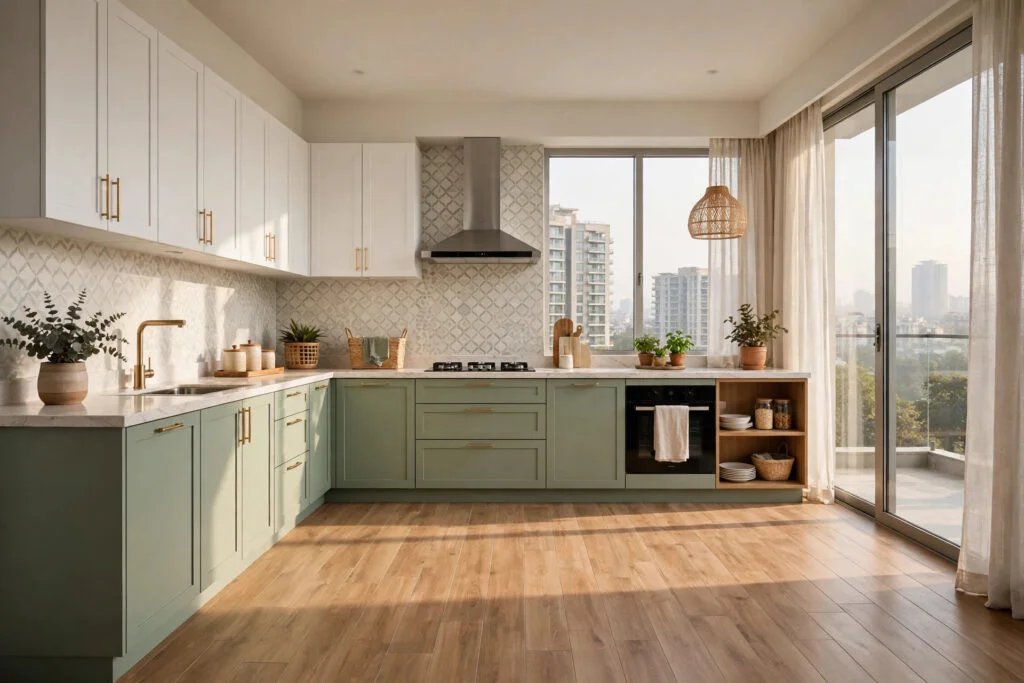
Three practical tips make SPC flooring for kitchen installations last:
- Use a mat at the sink. Not because the floor needs it — it doesn’t — but because a mat catches the daily drips and keeps the floor looking new with less wiping.
- Seal the edges. Ask the installer to seal the perimeter with silicone and fit matching SPC skirting (₹800/pc at Goals Floors). That stops water from ever reaching the subfloor from the sides.
- Mop, don’t flood. A damp mop with a mild cleaner is exactly what the product page recommends. Buckets of water thrown across the floor are the one thing to avoid — not because the planks will swell, but because standing water can find the joints over time.
At Goals Floors, the practical kitchen pick is Cobra Silver at ₹180/sq.ft — a warm oak tone that hides crumbs and water marks between mops — or Smoked Ash at ₹195/sq.ft if you want a deeper, premium wood look. If you are still wondering is SPC flooring waterproof enough for an Indian kitchen — with daily tadka splashes, steam and mopping — the answer is yes, and the kitchen is where SPC proves it every single day. An 80 sq ft kitchen costs roughly ₹14,400 in material at Cobra Silver, and around ₹16,000–₹19,000 fully installed at market labour rates of ₹20–₹60/sq ft.
SPC flooring for bedroom
A bedroom is a dry room, so waterproofing sounds less important there — until you remember what a bedroom floor actually goes through. SPC flooring for bedroom use is about comfort as much as water: the morning mop, the occasional spilled tea, the humid monsoon nights when a laminate floor would quietly swell at the edges.
SPC is warm underfoot compared to cold vitrified tiles, which matters the moment your feet touch the floor in the morning. The built-in cushion layer on the 6mm planks softens footsteps and keeps the floor silent — no creaks, no hollow click when you walk to the bathroom at night. And because the core is waterproof, the daily pocha and the monsoon damp that creeps up from the walls cannot damage it the way they damage laminate or engineered wood. So is SPC flooring waterproof enough for a bedroom? Yes — and the waterproofing is exactly what protects the floor through humid monsoon nights.

For bedrooms, the design choice matters more than the waterproofing, because any SPC design is waterproof. The Herringbone SPC at ₹215/sq.ft turns a master bedroom into a designer space — the chevron pattern reads as premium hardwood at a fraction of the price. Smoked Ash at ₹195/sq.ft, with its EIR real wood grain, is the safe premium choice for a bedroom that should feel warm rather than dramatic. Cobra Silver at ₹180/sq.ft is the value pick for a second bedroom or a rental. A 100 sq ft bedroom costs roughly ₹18,000 in material at Cobra Silver, or ₹21,500 in herringbone — and with 10% extra for cutting wastage, you have your budget in two minutes.
One bedroom warning worth knowing: SPC is a hard floor. It is softer than tile and quieter than cheap laminate, but it is firmer underfoot than carpet or WPC. If you like walking barefoot on something soft, a rug beside the bed solves it for a few hundred rupees — and the rug sits happily on a waterproof floor that will never stain from a spilled cup of chai.
SPC flooring for office
Offices are where waterproof flooring earns its money. SPC flooring for office spaces faces the three things that kill other floors: constant footfall, rolling chair wheels, and spilled tea and coffee. A laminate floor in a busy office shows wear at the doorway and swells at the pantry sink within two years. SPC does neither.
The 0.5mm wear layer on Goals Floors’ SPC is commercial-grade — the same thickness the product page credits with a 15–25 year lifespan even in moderate to heavy-use environments. Chair wheels roll smoothly on the rigid surface without denting it the way they dent soft vinyl. Tea and coffee spills wipe off the sealed wear layer. And when the office boy mops the whole floor every morning, the water is a non-event: the stone core simply does not absorb it. Ask is SPC flooring waterproof enough for an office pantry and entrance, where water and footfall meet daily — and the answer is the same yes.
For an office, the practical choices are simple. Smoked Ash at ₹195/sq.ft gives a professional wood look that suits cabins and meeting rooms. Cobra Silver at ₹180/sq.ft is the economical choice for large open work areas. A 500 sq ft office costs roughly ₹90,000 in material at Cobra Silver, or ₹97,500 in Smoked Ash — and installation is fast: the dry click-lock system goes over existing tiles or marble with no breaking and no cement, so a 500 sq ft office is typically finished in 24–48 hours, often over a weekend, with zero downtime on Monday morning.
Two office-specific tips: use chair mats under rolling chairs in the busiest spots — not to protect against water, but to protect the wear layer over years of identical rolling — and choose a mid-tone design like Smoked Ash, which hides dust and scuffs between cleanings far better than a very light or very dark floor.
SPC flooring for bathroom: yes, with two conditions
SPC flooring for bathroom use is the question where the honest answer has conditions. Yes, SPC can be used on a bathroom floor — the plank is 100% waterproof, and Goals Floors lists kitchens, basements and moisture-prone areas as suitable. Asked plainly — is SPC flooring waterproof enough for a bathroom? — the answer is yes, with the two conditions below. But a bathroom is not a kitchen: it has standing water, and that changes the rules.
- Condition 1 — outside the shower only. SPC works on the dry zone of the bathroom floor — around the basin, the WC and the walkway. It does not belong inside a shower area or anywhere water stands permanently. For the wet zone, tiles remain the right product.
- Condition 2 — sealed edges, wiped water. The perimeter must be sealed with silicone and finished with matching SPC skirting, and standing water should be wiped rather than left to sit for hours. The plank will not swell; the risk is only water finding its way through joints to the subfloor if it is left standing.
Used this way, SPC gives a bathroom something tiles cannot: a warm, wood-look floor that is comfortable barefoot and easy to clean. Many Delhi NCR homes now use SPC in the bathroom’s dry zone for exactly that reason — the same floor flowing from the bedroom into the attached bathroom, with no cold tile shock in the morning.
SPC flooring disadvantages: the honest list
No product is perfect, and a guide that only praises SPC would not be honest. Here are the real SPC flooring disadvantages, the same ones Goals Floors lists on its own product page:
- Hard underfoot. The rigid stone core that makes SPC waterproof also makes it firmer than WPC or carpet. The built-in cushion layer softens it, but if you want a soft floor, SPC is not it.
- It cannot be refinished. Hardwood can be sanded and re-polished; SPC cannot. A badly damaged plank is replaced, not repaired. The good news is that click-lock planks are designed to be lifted and swapped individually — a single plank replacement is a small job, not a floor replacement.
- It can sound hollow on a bad subfloor. Cheap SPC on an uneven subfloor clicks and echoes. Two things prevent this: a flat subfloor (the installer must check and level it first) and a quality plank with a built-in cushion layer, like the 6mm Cobra Silver.
- It needs a flat subfloor. SPC is rigid, so it shows every bump underneath. Old tiles with lippage or a wavy concrete slab must be levelled before installation — this is the step bad installers skip.
- It is not an outdoor floor. Waterproof does not mean weatherproof. SPC belongs indoors; balconies and terraces need WPC decking instead.
- It costs more than basic laminate. At ₹180–₹215/sq.ft at Goals Floors, SPC sits above budget laminate — but the market bands tell the same story: basic SPC is ₹120–₹180, mid-range ₹180–₹300 and premium ₹300–₹500+ per sq ft, and you are paying for a floor that survives water instead of one that fears it.
None of these disadvantages changes the waterproof answer. They change where SPC belongs — and for kitchens, bedrooms and offices, the answer is still yes.
SPC flooring lifespan: how long does it last?
The SPC flooring lifespan is one of the reasons the waterproof question matters so much: a floor that never swells simply lasts longer. Quality SPC flooring typically lasts 15–25 years when properly installed and maintained, according to Goals Floors’ own product page — and its commercial-grade 0.5mm wear layer can last even longer in moderate to heavy-use environments.
Four things decide where in that range your floor lands:
- Wear layer thickness. The 0.5mm wear layer on all three Goals Floors SPC designs is the single biggest factor. Cheaper 0.2–0.3mm wear layers show traffic paths in 5–7 years; 0.5mm lasts decades in a home.
- Installation quality. A flat subfloor, tight click-lock joints and sealed edges protect the floor for its whole life. A rushed installation on an uneven floor shortens it.
- Foot traffic. A bedroom floor lasts longer than an office corridor — obvious, but worth saying when you are choosing between designs.
- Maintenance. Daily sweeping, a damp mop with mild cleaner, and no harsh wire scrubbers: that is the whole maintenance routine, and it is what the product page prescribes. Avoid dragging heavy furniture without felt pads, and the wear layer stays intact.
For context, that 15–25 year SPC flooring lifespan is roughly double what a budget laminate floor delivers in a humid Indian home, and it is achieved without any polishing, re-coating or special treatment. The waterproof core is doing the work silently, year after year.
SPC flooring price in India: verified Goals Floors prices
The waterproof question usually comes with a price question, so here are the real numbers — verified live on goalsfloors.com on 26 November 2026.
| SPC design | Goals Floors price | Specs | Best for |
|---|---|---|---|
| Cobra Silver (G-F SPC 301) | ₹180/sq.ft (MRP ₹390) | 6mm with cushion, 0.5mm wear layer, 1220 x 153mm, handscrapped | Bedrooms, kitchens, budget homes |
| Smoked Ash (G-F SPC 303) | ₹195/sq.ft (MRP ₹490) | 6mm, 0.5mm wear layer, EIR real wood grain, 1220 x 183mm | Living room, offices, premium wood look |
| Herringbone (G-F SPC 302) | ₹215/sq.ft (MRP ₹495) | 6mm, 0.5mm wear layer, 600 x 125mm, handscrapped | Designer bedrooms, feature floors |
| Matching SPC skirting | ₹800/pc (2440mm) | 14mm x 14mm, SPC | Wall–floor blending, bathrooms |
| Floor transition reducer | ₹750/pc (2400mm) | 40mm x 10mm, SPC | Uneven floor connections |
| SPC T-profile | ₹750/pc (2400mm) | 40mm x 12mm, SPC | Same-level floor joints |
| Quarter round beading | ₹450/pc (2440mm) | 15mm x 15mm, SPC | Cabinet & glass edge finish |
Market ranges, for comparison only and labelled as market, not Goals prices: SPC material costs ₹70–₹250 per sq ft across India, installed SPC costs ₹170–₹400 per sq ft, and installation labour runs ₹20–₹60 per sq ft. Goals Floors’ ₹180–₹215 per sq ft sits in the mid-range — and every plank is 6mm thick with a 0.5mm wear layer, which is the specification that actually decides how long the floor lasts.
Worked budgets, so you can price your own room: a 100 sq ft bedroom in Cobra Silver costs roughly ₹18,000 in material and ₹20,000–₹24,000 fully installed. An 80 sq ft kitchen costs roughly ₹14,400 in material. A 500 sq ft office in Smoked Ash costs roughly ₹97,500 in material. Add 10% for cutting wastage — 15% for herringbone — and you have your budget before you call anyone.
Is SPC flooring waterproof vs laminate? The honest comparison
The comparison most buyers actually need is SPC versus laminate, because the two look alike and cost roughly the same — but they behave very differently around water.
| SPC flooring | Laminate flooring | |
|---|---|---|
| Is it waterproof? | Yes — 100% waterproof stone core | No — water-resistant only, HDF core swells |
| Kitchen | Yes, best use case | No — avoid |
| Bathroom (dry zone) | Yes, with sealed edges | No |
| Bedroom | Yes | Yes |
| Office | Yes | Yes, but pantry/entrance risk |
| Spill left overnight | Wipe it — no damage | May swell at joints |
| Daily wet mopping | Yes, damp mop | Lightly damp only, never wet |
| Lifespan | 15–25 years | 10–15 years (dry rooms only) |
| Goals Floors price | ₹180–₹215/sq.ft | Classic ₹90/sq.ft, Majestic ₹129/sq.ft |
The rule is simple: if the room ever sees water — kitchen, bathroom, office pantry, ground-floor rooms with monsoon damp — choose SPC. If the room is dry and the budget is tight, laminate at ₹90–₹129/sq.ft is a fair choice for bedrooms and living rooms. Our full comparison is in SPC vs laminate flooring, and the full price breakdown is in SPC flooring price in India.
Installation & care: keeping the waterproof promise
SPC’s waterproofing only works if the installation is right, so this section matters as much as the product itself. The good news is that SPC installation is the easiest of any premium floor: a dry, dust-free click-lock system that goes over your existing tiles, marble or concrete — no breaking, no cement, no dust. A standard home is finished in 24–48 hours.
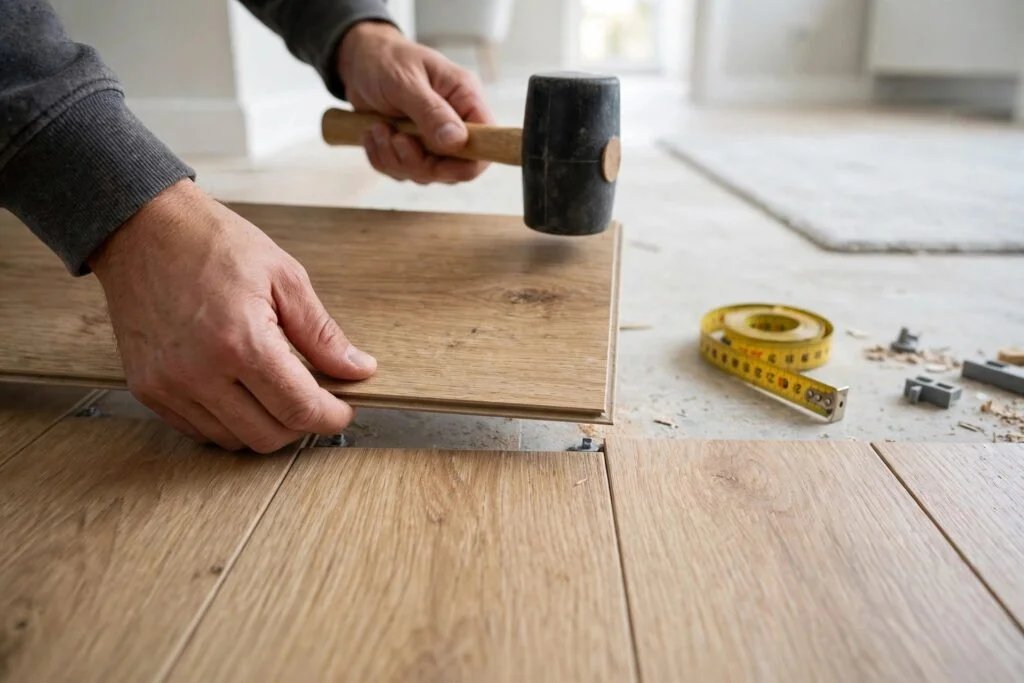
The five steps that protect the waterproof promise:
- Check the subfloor. It must be flat and clean. The installer levels any bumps first — this is the step that prevents hollow sounds later.
- Acclimatise the planks. Leave the boxes in the room for 24 hours so the planks adjust to your home’s temperature and humidity.
- Click, don’t force. Planks lock together at an angle and tap flat with a mallet. Forced joints are the ones that open up later.
- Leave an expansion gap. A small gap (8–10mm) around the walls, hidden by skirting, lets the floor expand and contract with temperature.
- Seal the wet edges. Silicone sealant and matching SPC skirting around kitchens and bathrooms stop water from ever reaching the subfloor from the sides.
Daily care is simple, and it is exactly what the product page recommends: sweep or vacuum daily, mop with a damp mop and a mild floor cleaner, and avoid throwing buckets of water or using harsh wire scrubbers. That is the whole routine — no polishing, no waxing, no special products — for a floor that stays waterproof for 15–25 years.
Final verdict: should you buy SPC flooring for wet rooms?
So — is SPC flooring waterproof? Yes, 100%. The stone core does not absorb water, the sealed wear layer shrugs off spills, and the product page’s own promise matches the material science. For kitchens, it is the best flooring choice in its price range. For bedrooms, it is warm, silent and worry-free. For offices, it is the floor that survives footfall, chair wheels and daily mopping for 15–25 years. For bathrooms, it works in the dry zone with sealed edges — and only the shower floor still belongs to tiles.
At Goals Floors, waterproof SPC starts at ₹180/sq.ft for Cobra Silver, ₹195/sq.ft for Smoked Ash and ₹215/sq.ft for Herringbone — all 6mm planks with a 0.5mm wear layer, installed in 24–48 hours over your existing floor. If your room ever sees water, that is the floor to buy. Chat with Goals Floors on WhatsApp with your room size, and we will suggest the best SPC design and give you the exact price — or visit the SPC flooring collection to see all three designs.
Frequently asked questions
1. Is SPC flooring waterproof?
Yes, SPC flooring is 100% waterproof. Its stone plastic composite core — limestone powder mixed with PVC — absorbs no water at all, so the planks never swell or warp. Spills, splashes and daily mopping are no problem. The only limit is flooding: if water stands on the floor for hours it can seep through the joints to the subfloor, so mop up spills and avoid throwing buckets of water on the floor.
2. Can SPC flooring be used in the kitchen?
Yes — the kitchen is the best use case for SPC flooring. It handles sink splashes, cooking spills, steam and daily wet mopping without swelling or staining. Use a mat at the sink, seal the edges with silicone and matching SPC skirting, and mop with a damp mop rather than flooding the floor. At Goals Floors, Cobra Silver at ₹180/sq.ft is the practical kitchen pick.
3. Is SPC flooring good for bedrooms?
Yes. SPC flooring for bedroom use is warm underfoot compared to tiles, silent thanks to the built-in cushion layer, and immune to the monsoon damp that damages laminate. Herringbone SPC at ₹215/sq.ft suits a master bedroom, Smoked Ash at ₹195/sq.ft suits a premium bedroom, and Cobra Silver at ₹180/sq.ft is the value pick. A 100 sq ft bedroom costs roughly ₹18,000 in material.
4. Can SPC flooring be used in bathrooms?
Yes, on the bathroom floor outside the shower area, with two conditions: seal the perimeter with silicone and matching SPC skirting, and wipe up standing water instead of leaving it. SPC does not belong inside the shower or anywhere water stands permanently — tiles remain the right product for the wet zone.
5. What are the disadvantages of SPC flooring?
The main SPC flooring disadvantages are that it feels hard underfoot, it cannot be refinished like hardwood (a damaged plank is replaced, not sanded), it can sound hollow on an uneven subfloor, it needs a flat subfloor before installation, and it is not an outdoor floor. It also costs more than basic laminate — ₹180–₹215/sq.ft at Goals Floors versus ₹90–₹129/sq.ft for laminate.
6. How long does SPC flooring last?
The SPC flooring lifespan is 15–25 years when properly installed and maintained. The 0.5mm wear layer on Goals Floors’ SPC is commercial-grade and is the biggest factor in that lifespan — cheaper 0.2–0.3mm wear layers show traffic paths in 5–7 years. Daily sweeping, a damp mop with mild cleaner, and felt pads under heavy furniture keep the floor in that range.
7. Is SPC flooring better than laminate for wet areas?
Yes. SPC flooring is 100% waterproof while laminate is only water-resistant — its wood-fibre core swells when water stands on it. For kitchens, bathrooms and any room that sees water, SPC is the right choice. Laminate is fine for dry bedrooms and living rooms, where it costs less (Classic ₹90/sq.ft, Majestic ₹129/sq.ft at Goals Floors).
8. How much does waterproof SPC flooring cost in India?
Waterproof SPC flooring at Goals Floors costs ₹180/sq.ft for Cobra Silver, ₹195/sq.ft for Smoked Ash and ₹215/sq.ft for Herringbone — all 6mm planks with a 0.5mm wear layer. Market ranges across India are ₹70–₹250 per sq ft for material and ₹170–₹400 per sq ft installed, with installation labour at ₹20–₹60 per sq ft. A 100 sq ft bedroom costs roughly ₹18,000 in material and ₹20,000–₹24,000 fully installed.
Written By
Goals Floors Team