
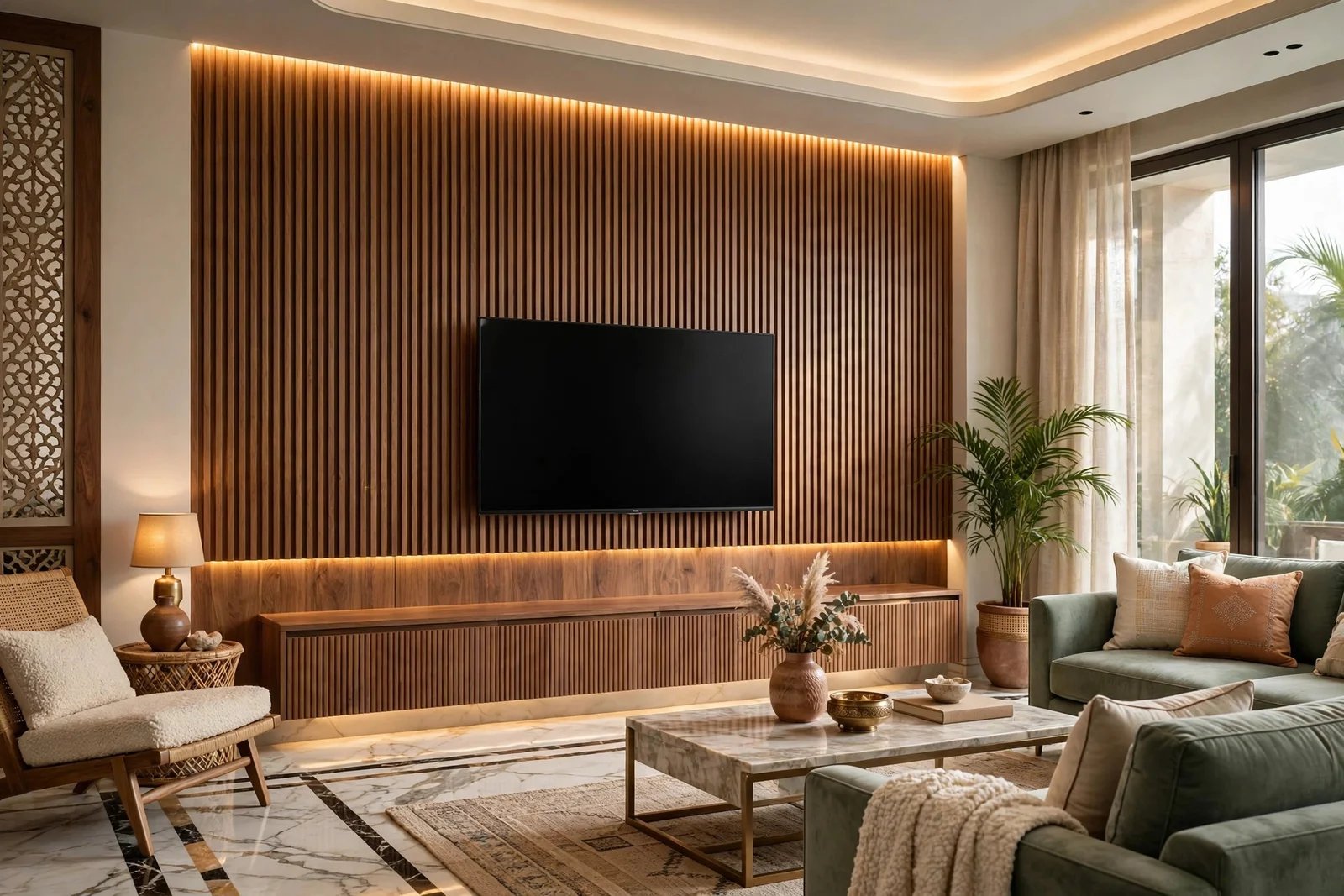
PVC vs WPC Wall Panels vs Charcoal: Price, Waterproof & Which to Choose in India
Walk into any interiors showroom in Gurugram or Delhi NCR and you will hear the same three names: PVC, WPC and charcoal. They are the three materials behind almost every modern feature wall, TV unit backdrop and bedroom headboard in India today — and they look confusingly similar in photos. So which one should you actually buy? This guide compares PVC vs WPC wall panels head to head, brings charcoal panels into the same comparison, and answers the questions buyers really ask: which is cheapest, which is waterproof, which is termite-proof, and which looks best in a living room, bedroom or TV wall. Every Goals Floors price below is verified from our own product pages; market figures are labelled as market ranges.
PVC vs WPC wall panels: quick answer
Short on time? Here is the PVC vs WPC wall panels comparison in one table, with charcoal added so you can see all three at once.
| PVC panels | WPC panels | Charcoal panels | |
|---|---|---|---|
| What it is | Plastic (polyvinyl chloride) panels, hollow or solid core | Wood fibre + plastic composite | Bamboo charcoal fibre composite sheets |
| Goals Floors price | From ₹499/panel (~₹53/sq.ft) | Fluted from ₹599/panel (~₹63/sq.ft) | Moulding from ₹119/pc; panels on WhatsApp |
| Market price (per sq ft) | ₹35–₹120 material | ₹99–₹350 material | ₹100–₹300 material |
| Waterproof? | Yes — water-resistant / waterproof | Yes — 100% waterproof | Water-resistant (dry walls only) |
| Termite-proof? | Yes | Yes | Yes |
| Best look | Marble, plain colours, glossy | Wood grain, fluted louvers | Dark, premium, matte luxury |
| Best for | Budget rooms, ceilings, rentals | Living room, TV wall, damp walls | TV wall, bedroom, luxury feature wall |
| Lifespan indoors | 10–15 years | 20+ years | 15–20 years |
The short verdict: PVC wins on budget, WPC wins overall for most Indian homes, and charcoal wins when the look matters most. The rest of this guide explains why — and what each one costs for a real wall.
What is a PVC wall panel?
A PVC wall panel is made from polyvinyl chloride — a lightweight, rigid plastic. The panels are hollow or solid core, click or slot together, and come in wood-look, marble-look and plain colours. At Goals Floors, the PVC range is the Primo series (GF-301–324, ₹499/panel) and the Elite PVC panel (GF-401, ₹549/panel) — both 2950 x 300mm, 5mm thick, covering 9.5 sq ft per panel.
PVC is the cheapest way to transform a wall. It is waterproof, termite-proof, easy to clean with a damp cloth, and installs in hours with adhesive — no cement, no dust, no carpentry. The marble-look PVC panels are especially popular: they give the look of a Calacatta marble wall at a fraction of the cost of real marble or UV marble sheets.
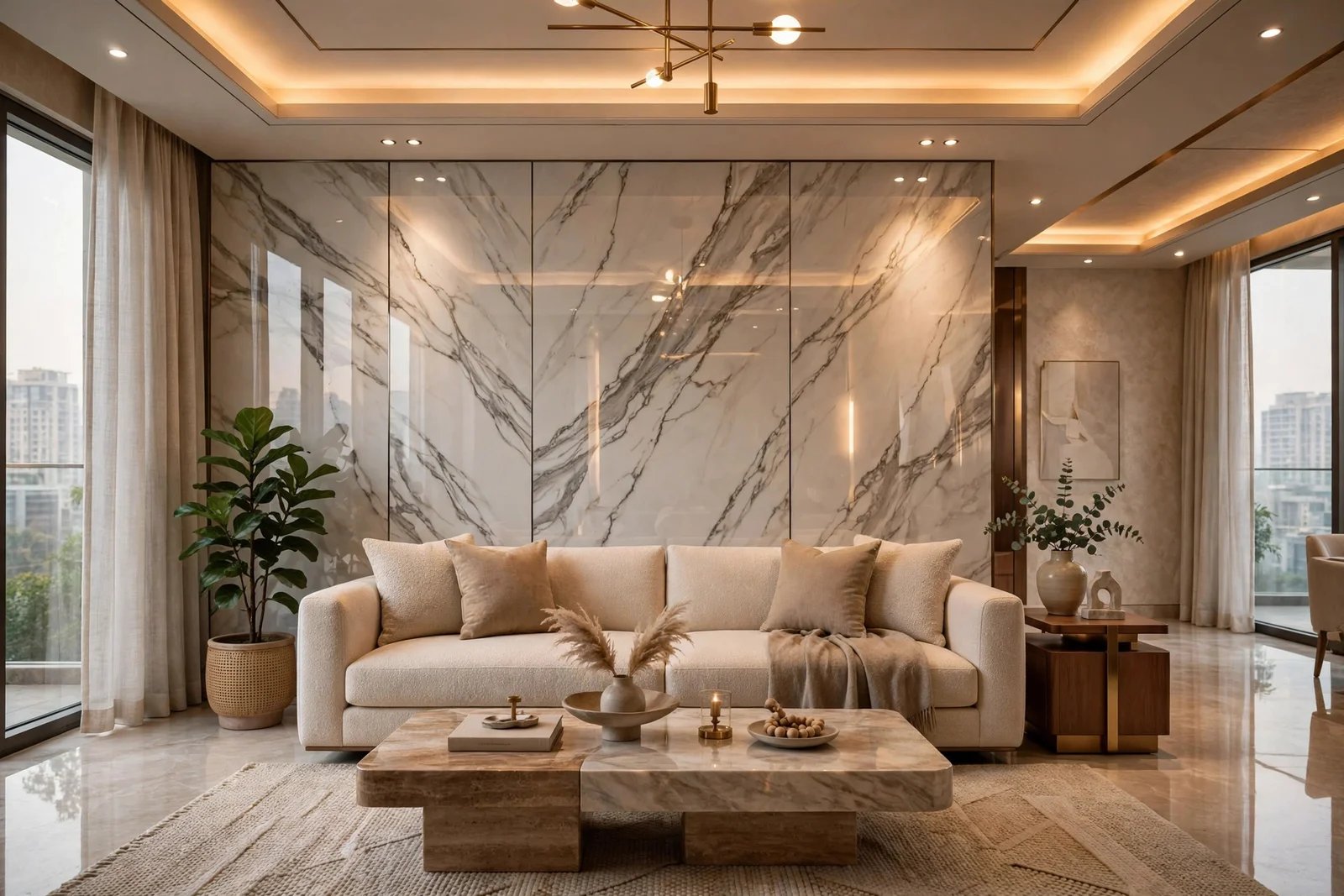
Where PVC falls short: it is the softest of the three materials, so it scratches and dents more easily than WPC or charcoal, and it can look plasticky in very large, well-lit feature walls. It is also the least premium to the touch. For a rental flat, a budget bedroom, a ceiling, or a wall you plan to redo in a few years, PVC is the sensible pick. For a forever-home living room, most buyers step up to WPC.
What is a WPC wall panel?
A WPC wall panel is made from wood fibre mixed with thermoplastic — wood plastic composite. It looks and feels much closer to real wood than PVC, because it contains actual wood fibre, and it is denser, heavier and harder to scratch. At Goals Floors, the WPC range is the fluted family: Primo Fluted (FP-701–713, ₹599/panel), Elite Fluted (FP-714–722, ₹599/panel), Metallic Fluted (₹650/panel) and the Premium 17mm Fluted (₹499/panel, A+ WPC) — all 2950mm long, designed for the vertical slatted look that dominates Indian living rooms and TV walls in 2026.
WPC is the all-rounder of the three materials. Goals Floors describes its WPC panels as 100% waterproof and termite-proof, and the material handles damp-prone walls — the seelan-affected walls common in Gurugram apartments — far better than MDF or plywood. It does not swell, warp or rot, needs only a wipe with a dry cloth, and the fluted profile hides small wall undulations that a flat panel would show.
The only real downside is price: WPC costs more than PVC per panel, and the premium 17mm fluted profile works out to roughly ₹94 per sq ft because each panel covers a narrower width. But for a feature wall you look at every day, the difference between ₹499 and ₹599 per panel is small against the total room budget — and the look is visibly more premium. That hardness and water resistance is the heart of the PVC vs WPC wall panels difference: PVC is lighter and cheaper, WPC is denser and tougher.
What is a charcoal wall panel?
A charcoal wall panel is made from bamboo charcoal fibre composite — a dense, hard material with a deep, matte, almost velvety finish. Charcoal panels are the luxury pick of the three: they are sold as flat sheets and fluted louvers in dark greys, blacks, walnut and stone finishes, and they are the material behind most of the dramatic dark TV walls you see on Instagram and in Gurgaon show flats.
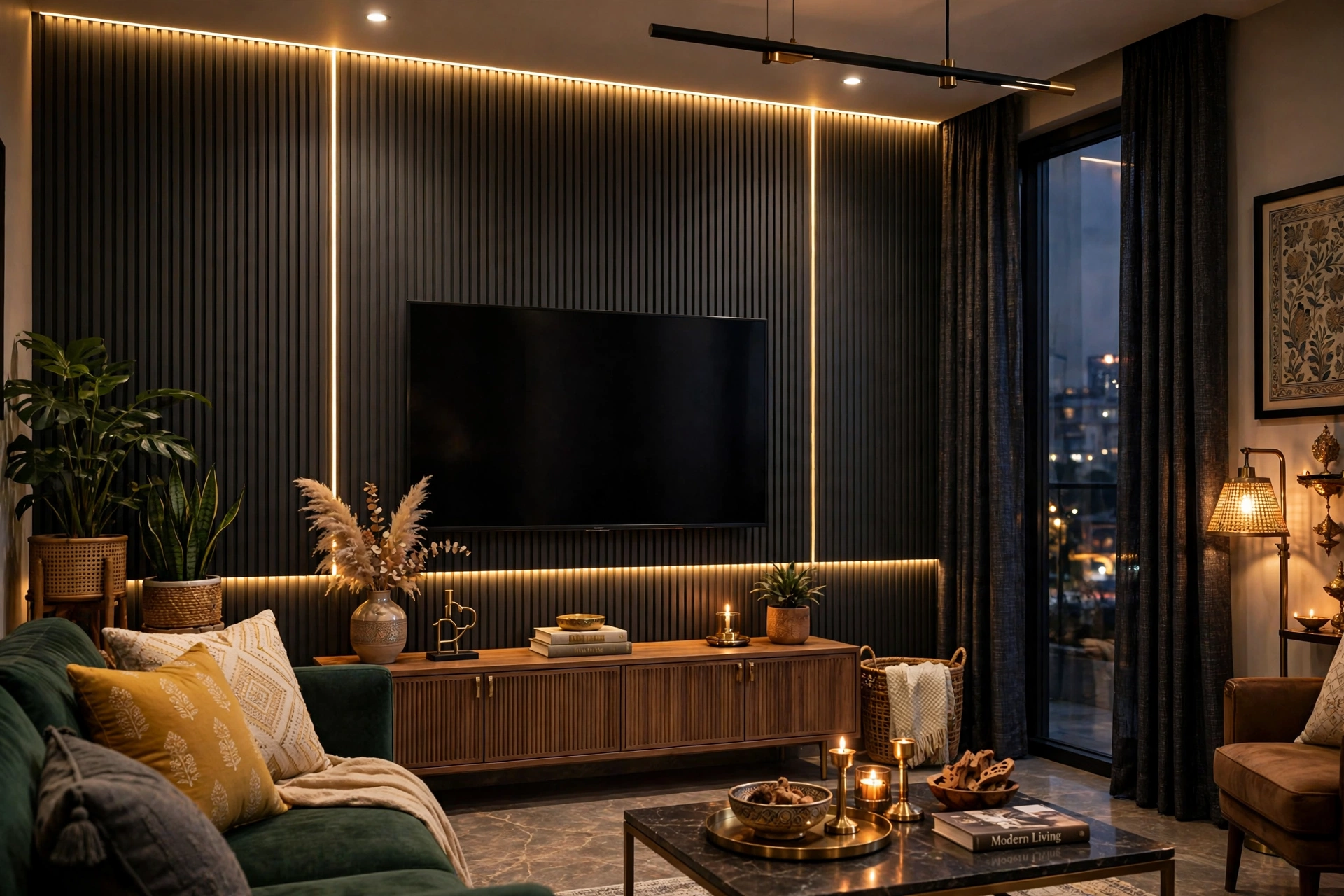
Charcoal’s strengths are its look and its hardness — it resists scratches and dents better than PVC, holds a crisp edge on fluted profiles, and pairs beautifully with warm LED strips and wooden furniture. Goals Floors sells the charcoal family as wall panels and as Tokyo charcoal moulding — pre-primed, paint-ready decorative strips from ₹119 per piece (8 ft) that frame a panelled wall or TV unit.
The honest limitation: charcoal panels are for dry interior walls. They are water-resistant and termite-proof, but they are not the right choice for a damp wall or a wet area — that job belongs to WPC or PVC. And because charcoal sheets are sold per sheet (market ₹2,500–₹8,000 for an 8×2 ft sheet), a full charcoal wall costs more than a PVC wall of the same size. For the exact charcoal panel price for your wall size, send the measurements on WhatsApp — the team will quote the available designs.
PVC vs WPC wall panels: price comparison
Price is where the PVC vs WPC wall panels decision usually gets made, so here are the real numbers. Goals Floors prices are verified from our product pages; the rest are market ranges, labelled as market.
| Range | Material | Size | Goals Floors price | Approx. per sq ft |
|---|---|---|---|---|
| Primo Series (GF-301–324) | PVC | 2950 x 300mm, 5mm | ₹499/panel | ~₹53 |
| Elite PVC Panel (GF-401) | PVC | 2950 x 300mm, 5mm | ₹549/panel | ~₹58 |
| Primo Fluted (FP-701–713) | WPC | 2950 x 300mm, 9mm | ₹599/panel | ~₹63 |
| Elite Fluted (FP-714–722) | WPC | 2950 x 300mm, 9mm | ₹599/panel | ~₹63 |
| Metallic Fluted | WPC | 2950 x 300mm, 9mm | ₹650/panel | ~₹68 |
| Premium 17mm Fluted | A+ WPC | 2930 x 169mm, 17mm | ₹499/panel | ~₹94 |
| Tokyo charcoal moulding | Charcoal | 2440mm (8 ft) strips | ₹119–₹629/pc | — |
| Charcoal panels | Charcoal | Sheets (market) | Ask on WhatsApp | ₹100–₹300 (market) |
See the full range here: Wall Panels at Goals Floors. For charcoal moulding profiles and prices, see Tokyo Charcoal Moulding.
Market ranges for the same materials across India: PVC ₹35–₹120 per sq ft for material (installed ₹65–₹175), WPC ₹99–₹350 per sq ft, charcoal panels ₹100–₹300 per sq ft, and fluted WPC ₹200–₹500 per sq ft at premium retailers. Goals Floors’ wholesale pricing sits at the lower end of every one of those bands — a Primo PVC panel at ~₹53 per sq ft and a WPC fluted panel at ~₹63 per sq ft are both below the typical market material range for their category. For the full cost breakdown — material, labour and room budgets — read our Wall Panelling Cost in India guide.
Are WPC panels waterproof?
Yes — are WPC panels waterproof is the question that decides the material for most buyers, and the answer is yes. WPC (wood plastic composite) is engineered to be 100% waterproof: the wood fibre is fully encased in plastic, so water cannot soak in and swell the panel the way it swells MDF or plywood. Goals Floors lists its WPC wall panels as 100% waterproof and termite-proof, and its own FAQ confirms high-quality WPC panels are waterproof for interior wall applications.
That matters in Indian homes for one specific reason: seelan. In Gurugram and Delhi NCR apartments, a wall that looks fine in summer can show damp patches after the monsoon. Paint bubbles, MDF swells, and wallpaper peels — but a WPC panel wall stays exactly as it was. It is the safest material for a ground-floor wall, a wall that shares a bathroom on the other side, or any wall that has shown dampness before.
Two honest caveats. First, “waterproof” describes the panel, not the wall behind it — if the wall itself has active seepage, fix the leak first, then panel over it. Second, PVC is also waterproof, so waterproofing alone does not settle the PVC vs WPC choice — the difference is that WPC is waterproof and harder, denser and more premium-looking. For a kitchen or a damp-prone wall, WPC is the better of the two; for a bathroom, neither wall panel is the right product — use tiles or SPC flooring for wet floors instead (SPC Flooring at Goals Floors).
Are charcoal panels termite proof?
Yes — are charcoal panels termite proof is easy to answer: charcoal panels are termite-proof. Termites eat cellulose — wood, MDF, plywood, paper. Charcoal panels are a bamboo charcoal fibre composite with no natural wood for termites to feed on, so termites simply ignore them. Goals Floors’ Tokyo charcoal moulding is listed as 100% termite-proof, and the same composite logic applies to the charcoal panel sheets.
The same is true of the other two materials: PVC is plastic, so termites cannot eat it; WPC’s wood fibre is encased in plastic and treated, so it is termite-proof too. In other words, termites do not decide this comparison — all three materials pass. What decides it is water, hardness and looks: WPC wins on water, charcoal wins on looks, PVC wins on price.
One related warning: termite-proof panels do not protect the wall behind them. If the wooden skirting, the plywood backing or the door frame behind the panel is untreated wood, termites can still attack that. A panel wall is only as termite-safe as its weakest layer, so use treated or non-wood backing, and keep the wall dry.
WPC vs charcoal panels: which is better?
WPC vs charcoal panels is the comparison buyers ask about once the budget allows either one — and the answer depends on the wall, not the material alone.
Choose WPC when the wall is damp-prone, the room is high-traffic, or you want the wood look. WPC is fully waterproof, harder than PVC, and its fluted profiles are the default choice for living-room feature walls and TV unit backdrops across Delhi NCR. A WPC fluted wall at ₹599 per panel (~₹63/sq.ft at Goals Floors) is also cheaper per square foot than most charcoal sheet installations.
Choose charcoal when the look is the priority and the wall is dry. Charcoal’s dark, matte, premium finish photographs better than any other panel material, and it is the right pick for a statement TV wall, a moody bedroom accent wall, or a luxury office cabin. Its fluted louvers with warm LED strips are the single most-requested TV-wall design in 2026.
Many of the best walls in Gurgaon actually combine the two: WPC fluted panels as the main field, with charcoal panels or Tokyo charcoal moulding as the frame, the border, or the TV niche. You get WPC’s waterproofing where it matters and charcoal’s drama where the eye lands — and the combination costs less than a full charcoal wall. For design ideas, see our 30+ Best Wall Panel Designs for Living Room & Bedroom.
Charcoal vs PVC panels: the budget question
Charcoal vs PVC panels is the widest price gap in this guide. A Primo PVC panel costs ₹499 (~₹53/sq.ft at Goals Floors); a charcoal panel sheet costs ₹100–₹300 per sq ft at market rates, before the moulding, adhesive and labour. A 100 sq ft wall is roughly ₹5,500 in PVC material versus ₹10,000–₹30,000 in charcoal material — charcoal can cost two to five times as much.
So when is charcoal worth it? When the wall is the room’s centrepiece — the TV wall in the living room, the headboard wall in the master bedroom, the reception wall in an office. These are walls you look at every day, and charcoal’s depth and finish are visibly different from PVC at that scale. When is PVC the smarter spend? Bedrooms you may repaint, rental flats, ceilings, large walls where the panel is a background rather than a feature, and any project where the budget has to cover flooring too.
A practical middle path: use PVC on the secondary walls and charcoal on the one feature wall. The room reads as premium — because the eye goes to the feature wall — while the total bill stays close to a PVC budget. And if the wall is damp-prone, swap the PVC for WPC fluted at ₹599 per panel: still far cheaper than charcoal, and fully waterproof.
PVC vs WPC vs MDF panels
PVC vs WPC vs MDF panels comes up because MDF is still the default material many carpenters suggest — and it is the one material in this comparison we would not recommend for Indian walls. MDF (medium-density fibreboard) is cheap and paints beautifully, which is why carpenters like it. But it is wood fibre glued together with resin, and it swells, warps and grows fungus the moment it meets moisture. One monsoon leak, one damp wall, and an MDF panel is ruined — and it is a termite magnet.
| PVC | WPC | MDF | |
|---|---|---|---|
| Waterproof? | Yes | Yes — 100% | No — swells and rots |
| Termite-proof? | Yes | Yes | No |
| Price (per sq ft) | ₹35–₹120 (market) | ₹99–₹350 (market) | ₹50–₹150 (market) |
| Best use | Budget walls, ceilings | Feature walls, damp walls | Dry furniture, not walls |
If a quote offers MDF panelling at a tempting price, ask what happens when the wall gets damp — then compare with a Primo PVC panel at ₹499 (~₹53/sq.ft) that will never swell. MDF belongs in dry furniture, not on Indian walls. For the full cost picture, see Wall Panelling Cost in India.
Which wall panel is best?
So which wall panel is best — the honest answer is that it depends on the room. Here is the room-by-room verdict:
- Living room / TV wall: WPC fluted, or charcoal if the budget allows. The TV wall is the room’s centrepiece — WPC fluted at ₹599/panel is the value pick, charcoal with LED strips is the luxury pick. See the TV-wall designs in our best wall panel designs guide (best wall panel designs guide).
- Bedroom: WPC fluted behind the bed, or charcoal for a premium master bedroom. PVC works for a budget bedroom, especially in marble-look or plain colours.
- Kitchen: WPC only — fully waterproof, wipe-clean, and handles steam and splashes. Never MDF, and avoid charcoal on a wall that shares a sink or dampness.
- Damp / seelan wall: WPC. It is the only material here that is fully waterproof and will not swell, warp or feed fungus.
- Ceiling: PVC — lightest, cheapest, and the easiest to install overhead.
- Office / commercial: WPC fluted or charcoal. Both handle heavy use, look professional, and install without shutting the office for days.
- Rental flat / budget makeover: PVC. Cheapest per panel, quickest to install, and easy to remove later.
If you want one material for the whole home and you do not want to think about it again, pick WPC. It is waterproof, termite-proof, premium-looking, and at ₹599 per panel it costs only ₹100 more per panel than PVC. If the budget is genuinely tight, pick PVC for the secondary walls and spend the saving on one WPC or charcoal feature wall.
Wall panel installation cost in India
Material is only part of the budget. The wall panel installation cost in India is typically ₹15–₹80 per sq ft for labour (market range), depending on the city, the wall condition and the profile. Installation barely changes the PVC vs WPC wall panels maths — the labour is the same for both materials, so the per-panel price gap is the whole difference. What changes the labour cost:
- Wall condition: panels glue straight onto flat, plastered walls. A damaged or uneven wall needs a plywood grid first, which adds material and labour.
- Profile: flat PVC panels are quickest to fit. Fluted and charcoal louvers take longer because each strip is aligned and levelled by hand.
- Adhesive and trims: heavy-duty PU adhesive, edge trims and corner profiles are charged separately — confirm them in the quote.
- Cutting and wastage: add 7–10% extra panels for cutting around switches, corners and skirting.
- Room size: larger walls cost less per sq ft — cutting waste falls and labour is spread over more area.
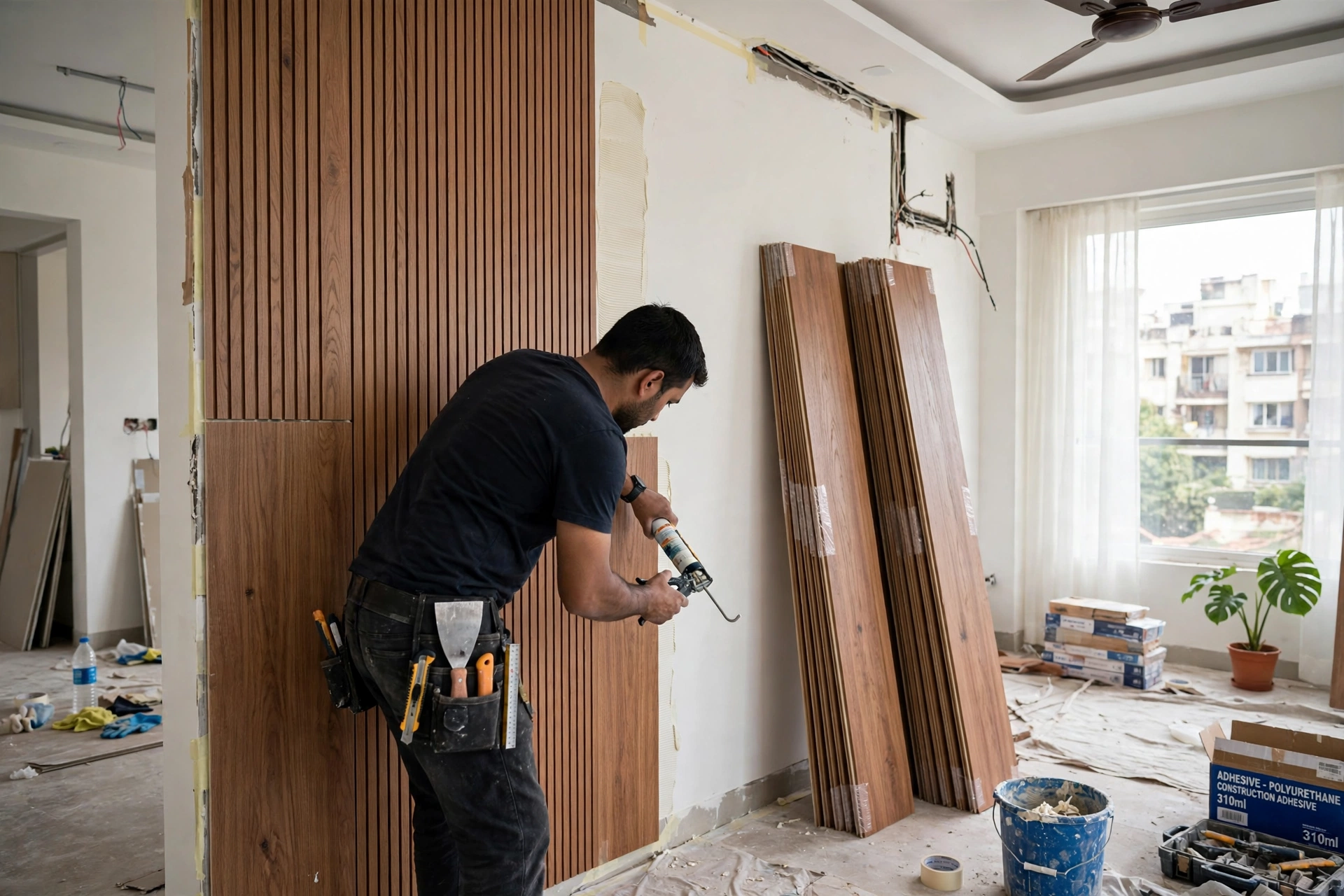
At Goals Floors, installation is done by our own team across Gurugram and Delhi NCR — dry, dust-free fitting with PU adhesive and concealed brad nails, usually finished in a day for a single feature wall. For an exact installation quote, send your wall measurements on WhatsApp and the team will share the total cost, adhesive and trims included.
Example budgets: what does a panel wall cost?
PVC vs WPC wall panels pricing only makes sense on a real wall, so here are worked examples for a 100 sq ft feature wall (10×10 ft), using Goals Floors material prices plus typical labour of ₹25–₹40 per sq ft. Add 7–10% extra material for cutting and wastage.
| Wall | Size | Material | Material cost | Installed approx. |
|---|---|---|---|---|
| TV wall | 100 sq ft (10×10) | Primo PVC ₹499/panel (~₹53/sq.ft) | ~₹5,500 | ~₹8,000–₹9,500 |
| TV wall | 100 sq ft (10×10) | WPC fluted ₹599/panel (~₹63/sq.ft) | ~₹6,600 | ~₹9,100–₹10,600 |
| TV wall | 100 sq ft (10×10) | Metallic fluted ₹650/panel (~₹68/sq.ft) | ~₹7,150 | ~₹9,650–₹11,150 |
| Bedroom accent wall | 80 sq ft (10×8) | Primo PVC ₹499/panel | ~₹4,400 | ~₹6,400–₹7,600 |
| Bedroom accent wall | 80 sq ft (10×8) | WPC fluted ₹599/panel | ~₹5,300 | ~₹7,300–₹8,500 |
| Feature wall | 100 sq ft (10×10) | Charcoal panels (market ₹100–300/sq.ft) | ~₹10,000–₹30,000 | ~₹12,500–₹38,000 |
How to calculate it yourself: measure the wall in sq ft (length x height), divide by 9.5 to get the number of 2950 x 300mm panels, round up, multiply by the per-panel price, add 10% for wastage, then add ₹25–₹40 per sq ft for labour. A 10×10 ft wall needs 11 panels: 11 x ₹499 = ₹5,489 in Primo PVC material — the maths takes two minutes.
FAQs — PVC vs WPC wall panels
Q1. What is the difference between PVC vs WPC wall panels?
PVC vs WPC wall panels differ in material and feel: PVC is lightweight plastic — cheapest, waterproof and termite-proof, best for budget walls and ceilings. WPC is wood fibre + plastic composite — denser, harder, more premium-looking, fully waterproof and termite-proof, and better for feature walls and damp walls. At Goals Floors, PVC starts at ₹499/panel (~₹53/sq.ft) and WPC fluted at ₹599/panel (~₹63/sq.ft).
Q2. Which wall panel is best, PVC, WPC or charcoal?
Which wall panel is best depends on the room: WPC is the best all-rounder for most Indian homes — waterproof, termite-proof and premium-looking. PVC is best on a tight budget or for ceilings and rentals. Charcoal is best for a luxury TV wall or bedroom feature wall on a dry wall. For damp walls, WPC is the only right choice of the three.
Q3. Are WPC panels waterproof?
Yes, WPC panels are 100% waterproof. The wood fibre is fully encased in plastic, so water cannot soak in and swell the panel. Goals Floors lists its WPC wall panels as 100% waterproof and termite-proof, and they are the recommended material for damp-prone and seelan-affected walls. Fix any active leak in the wall first, then panel over it.
Q4. Are charcoal panels termite proof?
Yes, charcoal panels are termite-proof. They are made from bamboo charcoal fibre composite with no natural wood for termites to feed on. Goals Floors’ Tokyo charcoal moulding is listed as 100% termite-proof, and the same applies to charcoal panel sheets. PVC and WPC are termite-proof too — termites do not decide this comparison.
Q5. What is the price of PVC vs WPC wall panels in India?
PVC wall panels cost ₹35–₹120 per sq ft for material at market rates; WPC panels cost ₹99–₹350 per sq ft. At Goals Floors, Primo PVC is ₹499/panel (~₹53/sq.ft) and WPC fluted is ₹599/panel (~₹63/sq.ft) — both at the lower end of the market bands. Charcoal panels cost ₹100–₹300 per sq ft at market rates; ask Goals Floors on WhatsApp for an exact charcoal quote.
Q6. Is charcoal better than WPC?
Charcoal is better than WPC for looks — its dark, matte, premium finish is the most dramatic of the three materials, and it is the top pick for luxury TV walls. WPC is better than charcoal for damp walls, durability and price: it is fully waterproof, costs less per square foot, and handles high-traffic rooms better. Many premium walls combine both — WPC fluted as the main field with charcoal as the frame or TV niche.
Q7. Can PVC wall panels be used in the kitchen?
Yes, PVC wall panels can be used in the kitchen — they are waterproof and wipe-clean. But WPC is the better kitchen choice: it is harder, more scratch-resistant, fully waterproof, and handles steam and heat better than PVC. Never use MDF panels in a kitchen — MDF swells and rots with moisture.
Q8. How much does wall panel installation cost in India?
Wall panel installation cost in India is typically ₹15–₹80 per sq ft for labour (market range), plus adhesive and trims. Flat PVC panels are quickest and cheapest to fit; fluted and charcoal profiles cost more because each strip is aligned by hand. A 100 sq ft TV wall costs roughly ₹8,000–₹9,500 installed in Primo PVC and ₹9,100–₹10,600 in WPC fluted at Goals Floors prices. Send your wall size on WhatsApp for an exact quote.
Final verdict
The PVC vs WPC wall panels decision comes down to three questions: your budget, your wall, and how long you want it to last. PVC at ₹499 per panel is the cheapest way to a beautiful wall — waterproof, termite-proof and perfect for budget rooms, ceilings and rentals. WPC at ₹599 per panel is the best value for most Indian homes — fully waterproof, harder, more premium, and the right answer for living rooms, TV walls and damp-prone walls. Charcoal is the luxury pick — the most dramatic look of the three, worth it on the one wall everyone sees, and best kept to dry interior walls.
If you want one rule to remember: damp wall or forever home, choose WPC; tight budget or rental, choose PVC; statement wall and dry room, choose charcoal. Measure your wall, count the panels, and you have your budget in two minutes — or send the measurements on WhatsApp and the Goals Floors team will quote the exact cost for your home. Visit the showroom in Sikanderpur, DLF Phase-1, Gurugram to see all three materials side by side before you decide.
Written By
Goals Floors Team